

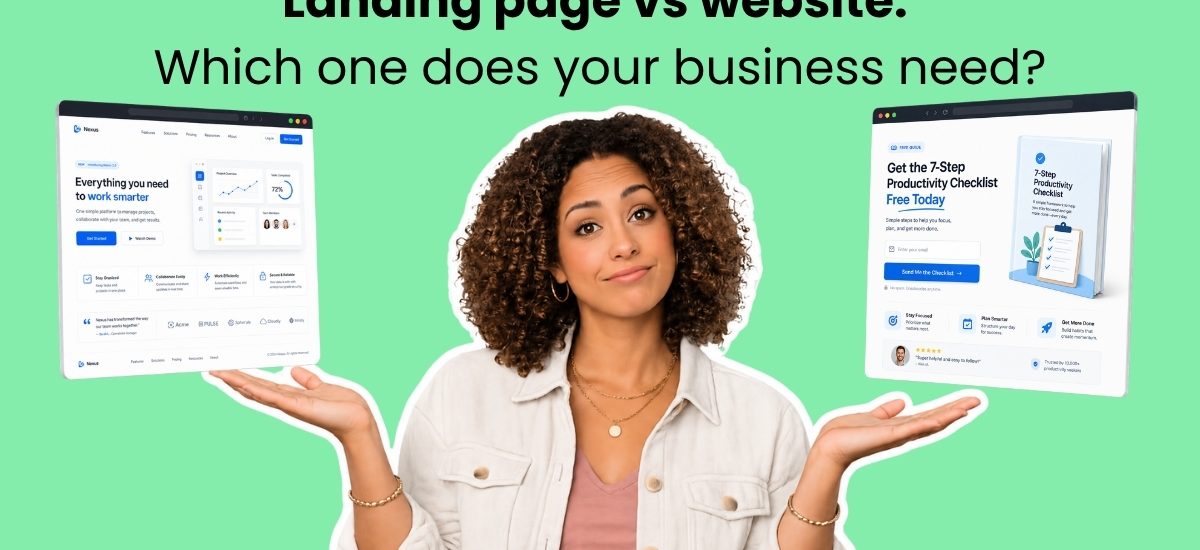
“Do I need a website? What should I use a landing page for? Do I need both?”
If you’ve asked these questions, you’re not alone. Like all online small businesses, you want to set yourself up for success right away.
Carving out a place for your business on the internet is a great way to start building your audience. But there is more than one way to do it.
In this blog, I’ll share the similarities and differences between landing pages and websites, how to choose which is right for you, and how to get started.
Landing Page vs. Website: Definitions
What is a website?
A website is usually made up of five or more web pages, including:
Homepage
About page
Features, services, or products page
Blog
Contact page
And more, depending on the business, it’s goals, and audience
The goal of a website is exploration. Visitors browse, learn about you, get answers to their questions, and build familiarity with your business over time.
A website is your one-stop shop for everything about your business. But that completeness comes at a cost. Websites take more time, money, and upkeep than a single landing page.
Check out the website for the podcast “Foodie Buddies” below. A visitor can easily navigate around the site to learn about the podcast, listen to the latest episodes, and get recipes.
What is a landing page?
A landing page is a standalone web page with one goal and one call to action. There’s no menu to click through and no other pages to wander off to. A visitor lands, reads, and either takes the action or leaves.
Common landing page goals include:
Growing your email list with a lead magnet
Selling a single product or service
Registering people for a webinar or event
Acting as a link in bio page for your social profiles
Because everything on the page points to one action, landing pages convert better than pages built for browsing. The visitor never has to decide where to click next. You’ve already decided for them.
For a full breakdown of how landing pages work, with examples by type, see What is a landing page?
Remember the Foodie Buddies podcast website? Well, the podcasters also use landing pages as part of their marketing strategy.
In this case, the landing page is functioning as a link directory. This lets them use one link in their social media bios to easily direct followers to.
This is just one way to use landing pages as part of your marketing strategy. In fact, there are tons of ways you can use landing pages.
Landing page vs website: the differences side by side
Think of your website as a continent. Many pages, all connected, easy to travel between. A landing page is an island off the coast. It stands alone, and every visitor who arrives sees exactly one thing.
Here’s how they compare:
Landing page
Website
Number of pages
One
Five or more
Navigation
None or minimal
Full menu connecting every page
Goal
One specific action
Exploration and education
Calls to action
One
Many, spread across pages
Time to launch
Minutes to hours
Days to weeks
Cost
Low, often included with email tools
Higher: hosting, design, maintenance
Best for
Campaigns, list growth, selling one thing
Established businesses with lots to show
The structural difference matters less than the behavioral one. A landing page asks your visitor to do one thing. A website invites them to look around.
When to use a landing page
Use a landing page when you want focus. If you’re running an ad, promoting a lead magnet, launching a product, or sharing one link on social media, a landing page keeps your visitor on task.
Landing pages also make sense when you want to test an idea before investing in it. You can build a page for a new offer in an afternoon, send traffic to it, and find out if anyone wants it before you spend a dollar on a full site.
And if you’re just starting out, a landing page gets you online today. No designer, no developer, no monthly hosting bill.
When to use a website
Use a website when your business has enough depth that one page can’t hold it. Multiple product lines, a content library, a portfolio, a team page. If visitors regularly need answers to different questions, a website gives each answer its own home.
A website also builds long-term search visibility. A blog with helpful content brings in visitors month after month, something a single landing page rarely does on its own.
One isn’t a replacement for the other, though. Even with a full website, landing pages still do the conversion work. Send your ad traffic and email promotions to focused landing pages, not your homepage. Your homepage has too many exits.
How to decide which one you need
Ask yourself four questions:
1. What do I want visitors to do? One specific action means landing page. Explore and learn means website.
2. Do I have the time and budget for a website right now? If not, start with a landing page. You can add a website later.
3. Am I testing an idea? Validate with a landing page first. Build the website once the idea proves itself.
4. Does my business have enough content to fill five pages? If you’d be padding pages just to have them, you’re not ready for a website. That’s fine.
Can you run a business on landing pages alone?
Yes. Plenty of creators, coaches, and solo businesses operate entirely on landing pages. One page to collect email signups. One to sell a digital product. One as a link in bio hub.
Email makes this work. Your landing page captures the subscriber, and your emails handle everything a website would normally do: education, trust-building, promotion. The list becomes the asset. The landing page is just the front door.
You can build that front door without a website, hosting, or code. With AWeber, you pick a template based on your goal, customize it with a drag-and-drop editor, and publish with hosting and a secure connection included. An AI-powered content creator helps you write headlines and copy, and a built-in Canva editor lets you design graphics without leaving the page. You can collect payments directly on the page, too.
Every signup flows straight into your email list, so the moment someone subscribes, your welcome email is already on its way.
Landing page vs website FAQ
What is the difference between a landing page and a website?
A landing page is a single standalone page designed to drive one action, like an email signup or a purchase. A website is a collection of connected pages designed for browsing and learning. Landing pages have one call to action and little or no navigation. Websites have full menus and many goals.
What is the difference between a microsite and a landing page?
A microsite is a small cluster of pages, usually two to five, built for a specific campaign, product, or event. It sits separate from a company’s main website and often has its own domain. A landing page is smaller still: one page, one call to action. Use a microsite when a campaign needs multiple pages of content. Use a landing page when you need one focused conversion point.
Do you need a website if you have a landing page?
No. A landing page works on its own. You can grow an email list, sell products, and run a business from landing pages without ever building a website. Many businesses start with a landing page and add a website later, once they have more content and offerings to showcase.
Is a landing page cheaper than a website?
Yes, in most cases. A custom website can cost thousands of dollars in design and development, plus ongoing hosting and maintenance. A landing page is often included with tools you already pay for. AWeber includes landing pages with hosting and SSL on every plan.
Can a landing page replace a homepage?
For a new or small business, yes. If your business does one thing, a landing page focused on that one thing often converts better than a traditional homepage. As your business grows and visitors need more information, a homepage with navigation becomes more useful.
Additional contributions by Sean Tinney
The post Landing page vs website: which one does your business need? appeared first on AWeber.