
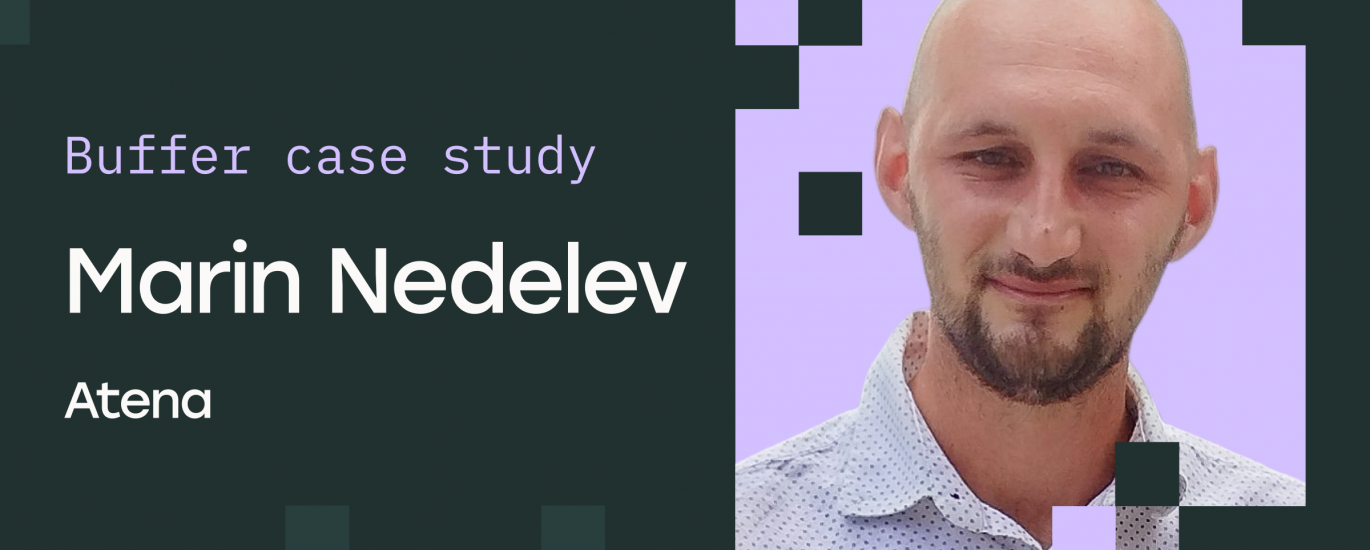
Marin Nedelev isn’t a developer, and he’d be the first to tell you that. But when you oversee marketing across 77 social media channels, 30 users, and ten different languages, you learn to build what you need.
Marin coordinates marketing at Atena, a caregiver staffing agency that connects caregivers from Central and Eastern Europe with families across the continent. The company operates in Slovakia, Romania, Hungary, Czechia, Bulgaria, Lithuania, Croatia, and Poland — and every country needs its own social media presence. Some channels recruit caregivers locally, others reach families looking for care. Marin oversees all of them.
Atena provides employment opportunities for caregivers across Europe
Why Marin needed a single tool for everything
Atena’s social media strategy is entirely organic. The margins in the caregiver industry are thin, and every Euro goes toward the people doing the actual care work rather than ad spend. That makes consistent posting across every channel the whole game.
As Atena grew, so did its need for organic reach — which meant expanding beyond Facebook and Instagram into TikTok, X, and LinkedIn. More platforms, more countries, more languages. What started as a manageable number of channels quickly became an operation that no one could run manually.
“We needed one tool to manage all of it,” Marin says. So his team evaluated the options the old-fashioned way: a spreadsheet of pros and cons, comparing Buffer against the top competitors across every category that mattered. Buffer won in every category except price, but after working with Buffer’s customer advocacy team on pricing that made sense for a high channel count, the price became comparable to tools that couldn’t match what Buffer offered.
Making Buffer his own with the API and no-code tools
Managing Atena’s channels through Buffer’s app gave Marin a solid foundation for posting and scheduling. But he needed to go further by mapping every channel to its department and country, then generating automated reports showing who posted what, where, and when.
He’d initially used Buffer’s tagging system to organize posts, but at the scale of eight countries and multiple languages, manual tagging couldn’t keep up. So he turned to Buffer’s API.
Using n8n, a no-code automation platform, Marin built a workflow that pulls channel data from Buffer’s API into a Google Sheet. Each channel is mapped to its country and department, and every week the system automatically generates a posting report broken down by department and geography without Marin touching a thing.
Marin’s Google Sheet
“With Buffer’s API and n8n, I automated our entire weekly reporting across eight countries,” Marin says. “No manual tagging, no spreadsheet wrangling.”
The n8n workflow
The how is just as interesting as the what. Marin uses automation tools and leans on AI to work through the technical pieces rather than writing API calls from scratch. It’s the kind of workflow a non-technical marketer could realistically pull off, which is kind of the whole point.
Scaling both consistency and reporting
With an entirely organic strategy, consistency is everything. Marin uses a uniform posting framework across departments with Canva templates that keep everything on-brand without approval bottlenecks. Content goes from creation to scheduling in Buffer without layers of sign-off. But running that volume of organic content across eight countries is exactly what pushed Marin toward the API — he needed reporting and organization that matched the scale of the operation.
Marin’s reporting dashboard
What comes next
Buffer’s API is still new, and we’re building it alongside the people who use it. Marin’s feedback is already shaping what comes next — he flagged the need for granular comment notifications by department instead of company-wide emails, and a way to monitor comments at scale. That input is going directly into the API roadmap.
“The API let me build exactly what I needed for my situation,” Marin says.
Buffer’s API is now available. You can start building today.