
The problem with proving personal profile ROI
Ask any B2B social or advocacy manager where their best-performing content comes from, and most won’t point to the company page. They’ll point to their CEO, their sales team, or a handful of vocal employees posting from their own profiles.
The data backs that instinct up. Personal profiles average roughly 7.6x more reach per post than company pages, according to Ordinal’s analysis of over 250,000 LinkedIn posts. A separate Refine Labs study found employee profiles generating 2.75x the impressions and 5x the engagement of the company page they were compared against, despite having fewer followers. It’s one of the reasons employee advocacy programs exist in the first place, and why we’ve written before about the trust and pipeline data behind employee advocacy.
The problem was never whether personal posts worked. It was proving it, and proving it in the same report as everything else. Likes and comments only tell part of the story. They don’t show whether a post actually grew someone’s audience, got their profile looked at, or reached the buyers a company most wants in front of: LinkedIn Premium subscribers, who tend to be more senior, more engaged, and further along in a buying journey.
That’s the gap LinkedIn’s new API data, and this update, close.
What’s new
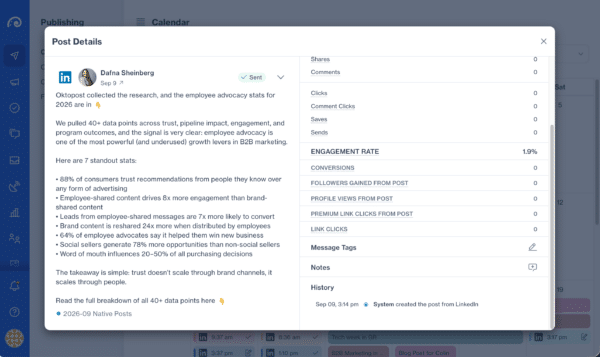
LinkedIn recently exposed a new set of post-level metrics through its API for the first time. Oktopost has added all three directly into reporting for LinkedIn personal-profile posts, alongside the engagement and reach metrics already tracked in Social Analytics.
No new setup, no separate dashboard. If a post is published from a personal profile connected to Oktopost, these new fields are simply part of its performance data going forward.
The three new metrics
Followers Gained From Post
The number of new followers directly attributable to a single post. This turns “did that post move the needle” from a guess into a number, useful for proving which content, topics, or formats actually grow an advocate’s or executive’s audience over time.
Profile Views From Post
The number of people who viewed the poster’s profile after seeing that specific post. For personal branding and advocacy programs, this is a meaningful mid-funnel signal, someone engaged enough to look past the post itself, whether that’s a prospect researching a sales rep or a candidate researching an employer’s team.
Premium Link Clicks
The number of LinkedIn Premium members who clicked a link inside the post. Because Premium membership skews toward more senior, sales-oriented, and highly engaged professionals, this metric gives social and advocacy teams a proxy for how content is landing with a higher-intent audience, without needing separate attribution tooling.
Where to find them
All three metrics appear alongside existing engagement data in Oktopost’s reporting for any LinkedIn personal-profile post. There’s nothing to turn on and nothing to configure, if a post qualifies, the data is there.
What this means for advocacy and social teams
Personal brand ROI, without the spreadsheet
Employee advocacy and executive personal branding programs have always had a reporting blind spot: everyone agreed the posts worked, but proving how well meant stitching together screenshots, self-reported numbers, or nothing at all. Followers Gained and Profile Views give advocacy leads a way to show, post by post, exactly what an executive’s or an advocate’s content is contributing, the same kind of proof point our Advocacy Agent work has been building toward for personalized, on-voice employee content.
Beyond vanity metrics
Likes and shares tell you a post was seen. They don’t tell you it worked. Follower growth and profile views are closer to what most advocacy and social teams are actually trying to influence: audience growth and brand visibility that outlasts a single post. Premium Link Clicks goes a step further, connecting content directly to a segment of LinkedIn’s audience that’s disproportionately likely to convert into pipeline conversations, without requiring a separate tool to work it out.
A stronger case for the personal-profile strategy
Teams that have already shifted budget and effort toward building out an employee advocacy program now have sharper reporting to justify it, and to a leadership team asking for numbers, “this post grew the CEO’s following by 40 and drove 12 profile views from Premium members” lands a lot harder than an engagement rate.
Worth knowing before you dig in
A couple of things to flag before these show up in customer conversations:
Personal profiles only. These three metrics are not available for company page posts. That’s a LinkedIn limitation, not an Oktopost one: LinkedIn’s API simply doesn’t expose this data for company pages.
No retroactive data. Metrics apply to posts published from now onward. Older posts will show 0, not because they underperformed, but because LinkedIn didn’t provide this data through its API until now.
Ready to see what your posts are really doing?
Vanity metrics were never the problem, they just weren’t the whole picture. These three fields fill in a piece of the personal-profile story that’s been missing since LinkedIn started favoring people over pages. For more on how that reach gap plays out across a full B2B program, see our LinkedIn Benchmark Report.
Already using Oktopost?
These metrics are live now. Open any recent LinkedIn personal-profile post in your reporting to see them, no setup required.
New to Oktopost?
Book a demo to see how Oktopost’s reporting connects personal-profile performance, employee advocacy, and company page activity in one place, and check out our recent AI Assistant product update for how we’re also cutting the time it takes to create that content in the first place.
The post Personal Brand ROI, Finally Provable: LinkedIn Personal Profile Metrics appeared first on Oktopost.