

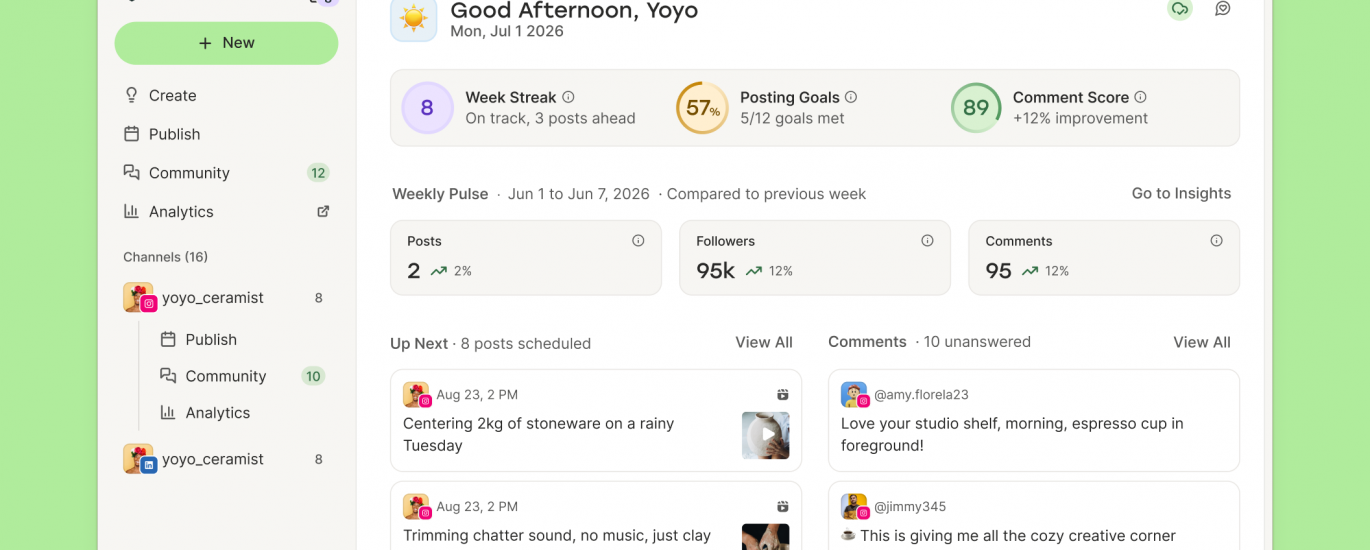
The Buffer app has never really had a home page. You sign up, you go through onboarding, and you land in Publish — a queue, probably an empty one, with a calendar and a lot of buttons.
For an experienced user, that’s great! The calendar is the product for a lot of people. But for someone who signed up four minutes ago, it’s a strange place to start. We were dropping new users into the “existing user” experience and hoping they’d figure out the rest.
We just launched Buffer Home to change that. This is the first major change to Buffer’s user experience since our visual redesign in March. I want to share a bit about it, as well as the strategy underneath it — why we built a home page in 2026, and where Buffer’s UX is heading from here.
The activation problem
For a couple of years, the biggest growth opportunity within our product was retention: getting people to come back. We invested heavily there (streaks, goals, lifecycle emails, a generally more polished product), and that work paid off to a degree, but we still had a significant activation challenge.
Activation is about helping more of the people who sign up reach an “a-ha!” moment from using Buffer as a social media toolkit, and while we’ve worked hard to offer more features and a better workflow to facilitate that “a-ha”, users need to find all those features first.
Our main tool for this, for over two years, was a welcome checklist. It worked, statistically, to increase activation a bit. But it was also more frequently dismissed than acted on, covered a small slice of what Buffer can do, and treated everyone identically — a solo creator, an agency, and a developer exploring our API all got the same four first steps.
So the first job of Buffer Home is to replace that checklist with a page that folks can engage with and meet them where they’re at. New users now land on Home after onboarding and see a small set of setup cards that reflect what they told us about themselves. (We’re running this as an A/B test with new signups, because we’d rather know than assume it helps.)
What it does for everyone else
If you’ve used Buffer for years, you don’t need help connecting a channel. For existing users, Home is a place to see the state of things before you go do the thing: your upcoming posts, comments you haven’t answered, and a summary of your posting habits. Everything is clickable, so it works as a launching point rather than a dashboard you admire and then leave.
The existing-user version is intentionally minimal in version 1. There’s a long list of things Home could surface — deeper insights, team activity, suggested content — and we left most of it out on purpose. We’d rather ship something we believe could still be valuable and learn from real usage than guess at the perfect page.
Where it could go from here
We have an ambitious vision and roadmap for Buffer over the next year: we’re overhauling our analytics and insights features, continuing to develop Community, and making Buffer more powerful for teams handling social. (And that’s not all!)
Home plays a key role in ensuring each of those developments, and ultimately, your most important social marketing tasks, are easy to find and use.
Let’s say you’re a contributor in a marketing agency, and you are responsible for drafting posts for review by an editor — there isn’t an easy way to simply act on review feedback. It takes 3 to 4 clicks to see the feedback today. I believe Home can and should surface those important review comments so you can act on them in one click.
A page that unlocks, rather than adds
The part I find most interesting strategically: Buffer Home introduces almost no new capability (yet!). Everything on it (posts, comments, templates, goals) existed before. What changed is how you encounter those things.
Buffer has grown a lot of surface area over the years, and when every feature lives behind its own tab, it’s only discovered by people who go looking. A home page flips that: it can progressively reveal the product based on where you are in your journey, instead of presenting fifteen doors and wishing you luck.
If you’re new to Buffer, you may already be seeing Home. If you’ve been around a while, it’s coming soon! I’d love to hear what you’d want from it. Check out our public roadmap for this feature or reach out to me on LinkedIn.