
Why it matters
In reading this blog, B2B marketers will learn how to measure brand awareness on social media without relying on clicks. They’ll see five real metrics to track instead: share of voice, saves and sends, mention volume, follower quality, and employee advocacy reach. They’ll also learn why impressions and follower counts are easy to misread, and how brand awareness differs from pipeline attribution.
Key takeaways
Buyers spend just 17% of their purchase journey in direct contact with vendors (Gartner). Most brand-building happens where no analytics tool can track it
Real awareness signals don’t need a click. Track share of voice, saves and sends, branded search growth, mention volume and sentiment, follower quality, and advocacy reach among ICP accounts
Impressions and follower count are easy to pull and easy to misread
Track awareness metrics monthly, not weekly. Brand awareness moves too slowly for weekly reports to show anything but noise
Brand awareness and pipeline attribution answer different questions. They belong on different review cadences, not the same weekly dashboard
The big picture
Gartner’s research on the B2B buying journey confirms something most marketers already suspect. Buyers spend only 17% of their purchase journey in direct contact with vendors. The other 83% happens away from any page you can track. Think peer conversations, analyst calls, Slack threads, and social feeds. A lot of that happens on LinkedIn. Almost none of it produces a click your analytics platform can see.
Brand awareness on social media means the right people recognize your company before they start evaluating vendors. That means your named buyer personas, at your named target accounts. It’s a precondition for pipeline, not a substitute for it. A buyer who’s never heard of you is colder than one who’s seen your name in their feed for a year. Even if neither one has clicked anything yet.
That’s the core problem with how most B2B teams measure social media. Every dashboard is built around clicks, form fills, and pipeline credit. That’s the data attribution models need. It’s the right lens for bottom-of-funnel content. It’s the wrong lens for brand awareness. Brand awareness does its work long before a buyer is ready to click on anything.
If your only social KPIs are click-through rate and MQLs, brand-building content will always look weaker than a demo-request ad. That’s true even in months when it’s quietly building the recognition that gets you shortlisted six months later.
Why brand awareness on social doesn’t show up in your pipeline report
A buyer scrolling LinkedIn during a commute isn’t clicking anything. They’re recognizing your name in a comment thread, screenshotting a stat from your post, or forwarding it to a colleague in a private message. None of that fires a UTM parameter or shows up in a last-touch model.
This is the same blind spot we’ve written about in dark social in B2B marketing: real influence that attribution tools can’t see. Brand awareness measurement starts from a different assumption than pipeline measurement. You’re looking for proof that more of the right people recognize and trust your company. Not proof that someone converted.
What are the metrics that track brand awareness on social media?
Most metrics that track brand awareness are available today inside whatever social analytics or listening tool your team runs. None of these require a click.
Here are the metrics:
Share of voice
Share of voice measures what percentage of relevant category conversation your brand owns, versus your named competitors. Say a competitor owns 36% of LinkedIn conversation in your category and you own 15%. That’s an awareness gap no pipeline report will surface. A pipeline report only shows deals you’re already in.
Oktopost covers the full calculation in our guide to share of voice in B2B social.
Branded search and direct traffic growth
When brand awareness rises, people start typing your company name into Google or an LLM. Or they go straight to your site instead of arriving through a paid or organic query. Pull branded query volume and direct traffic from Search Console and GA4 every month. Look for correlation with heavier social publishing or a spike in advocacy activity. This won’t prove causation on its own. But a consistent lift is a real signal.
Saves and sends, not just likes
A like takes half a second and means almost nothing. Someone saving a post to read later, or sending it to a colleague, signals real intent and recall, and it happens without a click your CRM will ever record. That gap in visibility was costing marketers credit for content that already worked.
Oktopost’s Social BI now surfaces LinkedIn saves and sends directly.
Mention volume and sentiment from social listening
Unprompted mentions across LinkedIn, industry forums, and news coverage are one of the cleanest awareness signals available. Nobody has to click a link for a mention to count. Track volume over time and pair it with sentiment, not just count. Our post on what B2B social listening should do for your pipeline goes deeper on setting this up. The awareness use case sits a level above the pipeline signals it focuses on.
Follower quality over follower count
A LinkedIn page adding 500 followers a month means very little if none hold titles that match your buyer personas. Pull a monthly sample of new followers. Check the mix of seniority and function. Growth among VP-and-above titles in your target industries beats raw follower count as an awareness indicator.
Employee advocacy reach among your actual buyers
Employee advocacy reaches people your company page’s algorithm-throttled feed never will. It rides personal networks instead of a brand account. Someone who never follows your company might see your VP of Sales’ post because a mutual connection engaged with it. Measure reach and engagement for your ICP segments, not total impressions. That tells you whether advocacy is building awareness where it matters. We break this down further in how to define employee advocacy ROI for enterprise B2B organizations.
A word of caution on impressions and raw reach
Impressions are the easiest brand awareness number to pull. They’re also the easiest to misread. LinkedIn’s algorithm favors video and native document posts, regardless of topic. So a spike in impressions can mean the format changed, not that more buyers noticed you. A follower count climbing after a paid follower campaign tells a similar false story.
Treat impressions and follower count as context. Never make them the headline metric in a board deck. Pair them with a harder signal, like share of voice or saves and sends, before concluding that awareness moved.
How to build a simple brand awareness dashboard
Pick four or five of the metrics above. Track them monthly, not weekly. Brand awareness moves slowly enough that weekly noise mostly hides the trend.
Benchmark your numbers against your own sector where you can. Our monthly LinkedIn benchmarks by industry post gives a useful baseline for engagement rate and posting cadence. That way, a change in your numbers means something relative to what’s normal for a company your size.
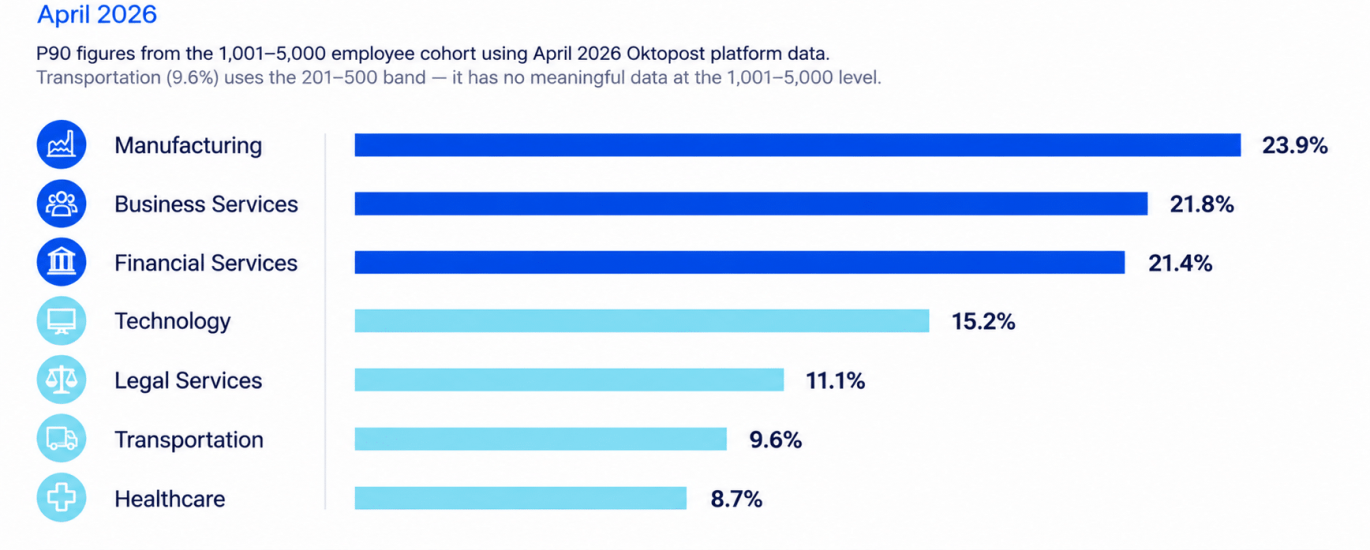
See below engagement benchmarks by industry:
P90 engagement rate by industry, April 2026. Source: Oktopost platform data.
Review the awareness dashboard alongside your pipeline dashboard on a quarterly cycle. Awareness metrics should inform strategy and budget conversations. They shouldn’t compete line-by-line against MQLs in a weekly standup. They’re not measuring the same part of the funnel.
Brand awareness and pipeline attribution are different jobs
This isn’t an argument against attribution. If you’re building the case for social’s contribution to revenue, read our guide on building a B2B social media dashboard that ties to pipeline. Also read our piece on social media reports for B2B.
The two dashboards answer different questions. Pipeline attribution tells you what social already closed. Brand awareness on social media tells you whether enough of the right people will recognize your name when they finally start that 17% of the journey where a vendor gets to participate at all.
Oktopost’s Social Analytics and Social Listening products were built to hold both categories in the same platform. That way, the awareness conversation doesn’t get starved every time budget season turns into an argument about last-touch credit. Want to see how that works for your team? Talk to an expert and walk through your own dashboard setup.
The post How to measure brand awareness on social media when your buyers don’t click appeared first on Oktopost.