
Why it matters
In reading this blog, B2B marketing leaders will see how competitor moves, buyer complaints, and analyst commentary show up on social weeks before they hit a press release or a G2 review. They’ll get a practical breakdown of the three layers worth tracking, mention tracking, share of voice, and buyer-signal detection, plus where these programs typically break down and how to avoid it.
Key takeaways
Competitor moves and buyer sentiment surface on social long before they reach a press release or review site, competitive marketing intelligence catches that gap
Three layers matter: brand and competitor mention tracking, share of voice over time, and buyer-signal detection at the account level
Mention volume without a share-of-voice trend or a routed buyer signal means the number just sits in a dashboard
The most common failure modes: treating mention counts as success, letting the keyword list scope-creep into noise, and losing the historical trend view
These programs only work with an owner on each side, content acts on mention data, sales development acts on buyer signals, and leadership tracks share of voice against pipeline
The big picture
A competitor quietly rolls out a new pricing page on a Tuesday. By Friday, three prospects have brought it up on discovery calls, and nobody on your team saw it coming until sales asked why you hadn’t mentioned it first.
That gap is where competitive marketing intelligence lives. Competitor announcements, analyst commentary, and customer complaints show up on social long before they reach a press release or a G2 review. Marketing teams that track this well spot a shift in the market weeks before it surfaces in a deal-review call. Teams that don’t find out from a prospect instead.
For B2B marketing and RevOps leaders, this is the practical core of the Q3 2026 push toward learning from social data rather than just publishing into it. Social platforms aren’t only a distribution channel anymore. They’re a live feed of what competitors are building, what buyers are complaining about, and what your own brand sounds like when nobody’s pitching it.
What competitive marketing intelligence actually covers
For a B2B marketing team, competitive marketing intelligence means turning public social activity into decisions: a campaign brief, a battlecard update, a sales alert on a live deal. Counting mentions is the easy part. Getting that data in front of the right person before it’s stale is the actual work.
Generic market research tells you what an industry believes over a quarter. Competitive marketing intelligence tells you what’s happening this week: a competitor’s new hire posting about a product they haven’t announced yet, a prospect asking your community team the same pointed question three times, an analyst quoting your rival in a thread you weren’t tagged in.
A product launch is the clearest version of this. The press release lands weeks after the real work already started. Job listings hint at a new feature set long before anyone confirms it publicly, and the competitor’s own product team often teases screenshots on LinkedIn well before that. Customer questions about the same feature start piling up in a shared industry group around the same time. A marketing team watching those channels gets a head start most competitors hand over without realizing it.
Brand and competitor mention tracking
The starting point is knowing who’s talking about you, who’s talking about your competitors, and where. That includes LinkedIn posts and comments, X threads, niche industry forums, and news coverage that never makes it into a Google Alert. Manually scanning these channels doesn’t scale past a handful of keywords, and most teams give up after the first few weeks.
A social listening program built for B2B narrows this down to queries that matter: your product name, your competitors’ product names, category terms your buyers use, and the executives most likely to say something quotable. Our query template guide walks through how to build those queries so the results stay relevant instead of drowning in noise.
The channel mix matters as much as the keyword list. LinkedIn carries most of the B2B conversation that’s worth tracking, from executive posts to comment threads under a competitor’s announcement. Niche forums and Slack communities carry a different kind of signal, usually more candid and closer to what a buyer actually thinks before a vendor is in the room. A program that only watches one channel misses half the picture, and the half it misses is often the more honest half.
Share of voice across channels
Mention volume alone doesn’t tell you whether you’re winning or losing ground. Share of voice does. It measures how much of the conversation in your category belongs to you versus your named competitors, tracked over time and broken out by channel.
A drop in share of voice on LinkedIn ahead of a renewal season is a signal worth escalating to sales enablement, not just a chart for a monthly report. A spike tied to a competitor’s funding announcement tells you exactly when to brief your team on how to respond.
For a full breakdown of how to calculate and benchmark this metric, see our guide to share of voice for B2B social.
Buyer-signal detection
The most valuable layer sits above mentions and share of voice: buyer signals. These are the moments when someone in your target account engages with a competitor’s content, asks a pointed question in a public group, or posts about a problem your product solves.
Sales teams have relied on this kind of signal informally for years, usually because a rep happened to see the right LinkedIn post at the right time. Building it into a repeatable process means someone in marketing or sales development gets an alert the same day, not three weeks later when the deal has already gone to a competitor.
Our post on turning social listening into pipeline signals covers how teams route these alerts to the reps who can act on them.
Turning monitoring into an actual workflow
None of this matters if the data sits in a dashboard nobody checks. The teams that get real value from competitive marketing intelligence build a cadence around it: a weekly review with content and demand gen, a standing alert to sales development for named-account signals, and a monthly rollup for leadership that ties social conversation to pipeline movement.
That cadence needs an owner on both sides of the workflow. Content needs mention data to know what to write about next, and sales development needs buyer signals routed to the right account owner without delay. Leadership’s job is different: keep the share-of-voice trend line next to the pipeline numbers instead of buried in a report nobody reads. Skip either handoff and the data stops being intelligence and goes back to being noise.
3 common failures where these programs quietly break down
The most common failure mode isn’t bad data. It’s treating mention volume as the finish line. A dashboard that shows 400 mentions this month looks like progress, but a VP Marketing can’t take that number to a pipeline review, and a sales rep can’t do anything useful with it on a call. Without a share-of-voice trend or a routed buyer signal, that number just sits there.
The second failure mode is scope creep. A team starts with three competitors and a handful of keywords, then adds every tangential term anyone in a meeting suggests. Within a quarter, the alerts are too noisy to act on, and the team quietly stops checking them. Keeping the query list narrow and reviewed monthly does more for a program’s survival than any dashboard feature.
The third is losing the historical view. A single mention or a one-week share-of-voice dip doesn’t mean much on its own. Trend data over several months is what shows whether a competitor’s PR push actually moved the needle or whether last week’s spike was a one-off. Programs that only look at this week’s numbers end up reacting to noise instead of tracking real shifts.
How Oktopost turns social monitoring into competitive intelligence
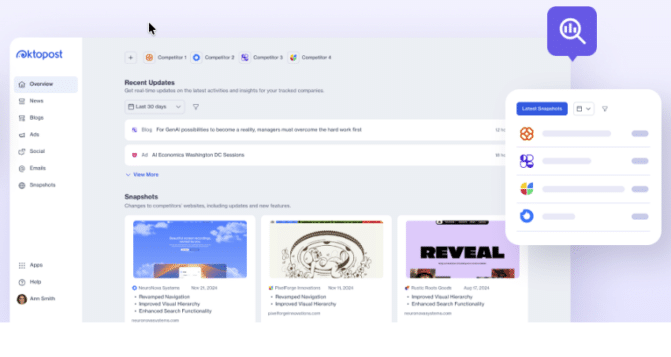
Oktopost’s Social Listening product is built for this exact workflow, and it’s sold and run as its own product rather than a bolt-on feature inside a publishing tool. It tracks brand and competitor mentions across social channels and news, and calculates share of voice by competitor and channel. AI clusters those conversations by topic, so a team can spot what matters without reading every mention by hand.
Buyer-signal detection links directly into the workflow marketing and sales already run: signals surface in account-level dashboards, and social engagement links to lead scoring and account records in Salesforce or Marketo, so a spike in competitor mentions on a target account shows up next to that account’s other activity instead of living in a separate tool.
Historical backfill solves the trend problem directly. Instead of starting a share-of-voice chart from a blank slate, a new program can pull months of prior mention data and see the trend line from day one, rather than waiting a full quarter to know whether this month’s number is normal or a real shift.
Finastra’s marketing team ran into this exact problem before centralizing on Oktopost. Publishing sat apart from employee advocacy, and social listening sat apart from both, which made it hard to see the full picture or grow share of voice across the financial services category as a connected effort. Centralizing the work gave their team one place to track competitor activity and employee-driven reach together.
Read the full Finastra case study.
Getting started with competitive marketing intelligence
Start narrow. Pick your three closest competitors, your own brand name, and the category terms your buyers actually type into a search bar or say out loud on a call. Set a weekly review cadence before you add a single additional keyword. Most teams that abandon social listening fail from a lack of ownership, not bad data.
If you’re ready to see how a B2B-built social listening program tracks competitor activity and surfaces buyer signals in one place, talk to our team about a walkthrough of Oktopost’s Social Listening product.
The post Competitive marketing intelligence: what B2B teams can learn from social data appeared first on Oktopost.