
The big picture
Ask a B2B marketing team whether social is working and the answer is usually, “Yes! Engagement is up.”
Ask whether it’s influencing pipeline… and the room goes quiet.
A large B2B equipment services company described its own situation in almost exactly those terms. Social was driving engagement, but the pipeline impact was unclear. The team had little visibility into how strategic accounts interacted with its content. Social signals weren’t being used to prioritize sales outreach or account-based marketing (ABM). Employee advocacy adoption was strong, yet nobody could measure its return. And scaling any of it took a heavy lift from internal teams.
What the company wanted instead was clear: social as a measurable channel, with engagement linked to CRM contacts, accounts, and opportunities. It wanted marketing and sales to spot key accounts as they engaged, advocacy scaled with structure, and reporting leadership could actually use.
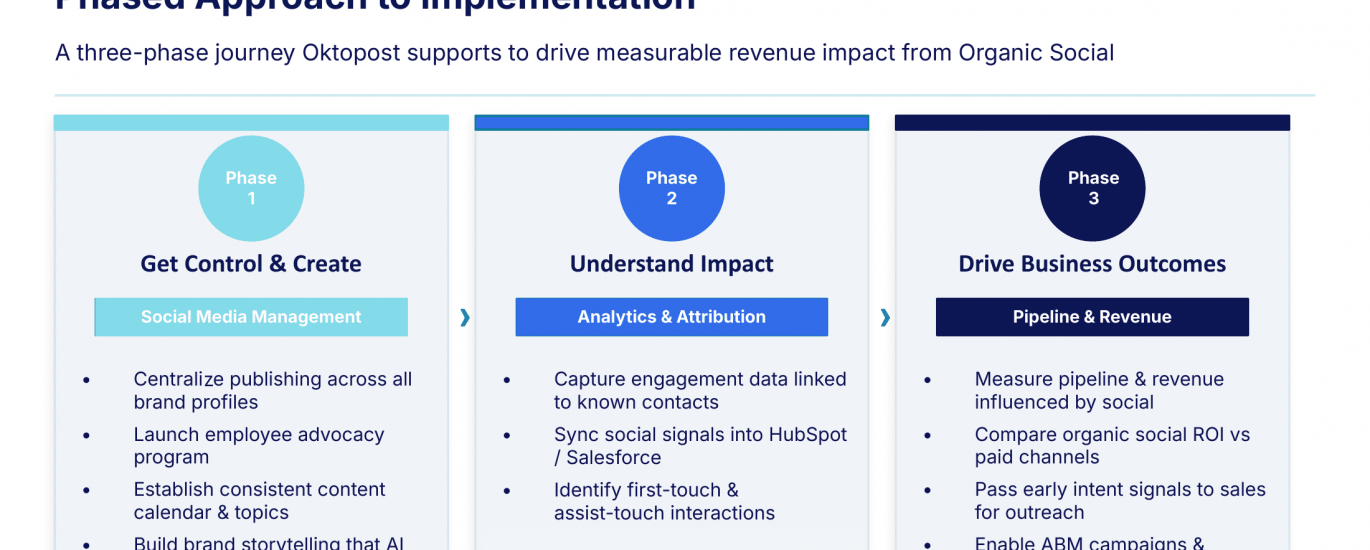
Getting from the first picture to the second doesn’t happen in one go. Most teams, like the one in the example above, move through three phases. We call this the Oktopost B2B Social Revenue Maturity Model, and skipping a phase is the most common reason attribution projects stall.
Phase 1: How do teams get control of social first?
Teams get control of social by managing all publishing in one place before they chase attribution. Attribution is impossible when publishing is scattered across tools, teams, and personal accounts, because the data has nowhere to come from.
Centralize publishing across every brand profile, using social media publishing that keeps campaigns, topics, and tags consistent.
Launch an employee advocacy program, since employees usually carry most of a company’s organic reach.
Set a consistent content calendar and topics, so performance can be compared over time.
Build brand storytelling that AI models recognize. LinkedIn content increasingly shapes what AI answer engines say about a brand, as this look at LinkedIn and AI citations shows.
Governance belongs in this phase too. Roles, teams, approval workflows, and controlled access to corporate profiles let regional teams move quickly while a central team keeps oversight.
Advocacy is often the first place this phase shows results. As Daniel Klaus, Senior Manager of Global Digital Marketing at Fujitsu, put it: “When we look at the last 6 months, Oktopost’s employee advocacy solution enabled our employees to share 10X more social content, generating a 70% increase in our organic social reach.”
Phase 2: How do teams understand social’s impact?
Phase 2 is where social stops being a set of aggregate numbers and starts being about real people. The goal is to connect engagement to known contacts.
In practice, that means engagement is matched to named people and the accounts they work for, wherever the social network and the CRM data make that match possible. When that engagement syncs to the CRM, marketing and sales can see which known contacts and accounts are paying attention.
Once the data lives in the CRM, it becomes usable well beyond reporting. In a marketing automation platform, it can drive segmentation, lead scoring, and nurture workflows.
For example, in Salesforce, the data supports account intelligence, personalized outreach, and account-based campaigns. For a deeper look at the Salesforce side, see how B2B teams connect social activity to Salesforce pipeline.
Phase 3: How does social start driving business outcomes?
With control in place and engagement tied to contacts, social can finally be measured like every other go-to-market channel.
Measure pipeline and revenue influenced by social, from the opportunity up.
Compare organic social’s return against paid channels on the same scorecard.
Pass early intent signals to sales, so reps reach out while an account is paying attention.
Power account-based campaigns and tailored nurture, based on the topics each contact has engaged with.
How do social engagers who aren’t in the CRM become leads?
Social engagers who aren’t in the CRM become leads once they’re identified, enriched, and added as new contacts. Not everyone who engages with a post is already there, and those people can be a valuable signal, because they’re new.
A simple three-step workflow helps close the gap. Where a social network shares who engaged, Oktopost captures those profiles and their engagement with company and advocate content. The team then enriches the profiles with its own data tools and decides, using its CRM rules, which ones become new leads.
Not every engager can be identified, because networks limit what they share. Treat this workflow as a steady source of new names, not a complete list of everyone who saw a post.
One tip: the posts that generate the most engagement aren’t always the ones that generate the best leads. Here’s why your best-performing post might not be your best lead source.
Which phase is your team in today?
Score each statement below with 0 for “not yet,” 1 for “partly,” or 2 for “yes.” Each phase has three statements, so each phase scores out of 6.
PhaseStatementScore (0, 1, or 2)Phase 1All brand and advocacy publishing is managed in one place.Phase 1Campaigns, topics, and tags are used the same way across teams.Phase 1An employee advocacy program is live, with approved content to share.Phase 2Social engagement shows up on contact and account records in the CRM.Phase 2Marketing uses social engagement in segmentation, scoring, or nurture.Phase 2There’s a process for adding new social engagers to the CRM.Phase 3We can report the pipeline social influenced last quarter, as first touch or assist.Phase 3Sales receives social engagement signals for target accounts and acts on them.Phase 3Organic social and paid channels are compared on the same scorecard.
Your current phase is the first one where your score is below 5. Here’s what to do next:
Below 5 in Phase 1: Centralize publishing and governance before anything else. Attribution won’t work without it.
Below 5 in Phase 2: Connect social to the CRM so engagement sits on contact and account records.
Below 5 in Phase 3: Start reporting influenced pipeline and route engagement signals to sales.
5 or more in every phase: Social is working as a pipeline channel. Now focus on comparing it with paid and growing its share.
Where to start
Social becomes a pipeline channel in three steps: get control, connect engagement to real contacts, then measure outcomes. That’s the route from the situation the equipment services company described to the measurable channel it’s aiming for, and it starts with structure, not a revenue dashboard.
Teams that try to jump straight to revenue attribution without the first two phases usually end up with a dashboard nobody trusts.
Scored your team and want help with the next phase? Request a demo.
The post The Oktopost B2B Social Revenue Maturity Model: 3 Phases From Social to Pipeline appeared first on Oktopost.