

Why it matters
In reading this post, marketers will gain a clear way to respond when a client questions organic social’s ROI. This post explains how Oktopost ties organic social to pipeline by connecting branded search, direct traffic, and assisted conversions to CRM data. That makes the case for cutting the budget hard to defend.
Key takeaways
B2B buyers now complete 70% to 80% of their purchase journey before ever engaging a sales rep, according to Gartner’s 2026 research, meaning most of organic’s influence happens before a last-click tool can see it.
Judging organic by the same last-click ROI standard as paid is a mismatched expectation, not proof the channel doesn’t work.
Cutting organic is almost always a measurement problem, not a channel problem, and Oktopost’s platform is built to solve it by tying that activity to CRM pipeline and revenue.
The Use Case
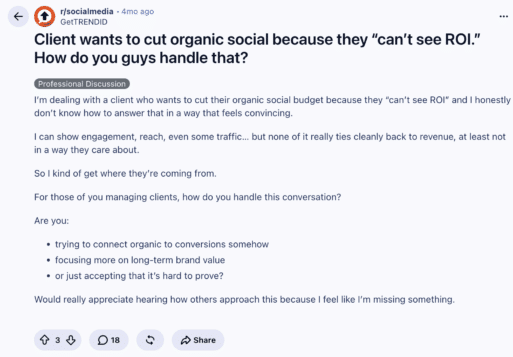
A marketer posted on Reddit that a client wants to cut their organic budget because they “can’t see the ROI.” The marketer explains that they can show engagement and reach, even some traffic, but none of it ties cleanly to revenue.
The replies in that thread land on the same idea from different angles.
For example, one user said the conversation goes better once you stop trying to prove organic works the way paid works, because it doesn’t, and it was never going to. In their own words:
“What helped me was reframing it. Instead of trying to prove direct ROI, I’d show what role organic is playing in the bigger picture. Things like how many people are discovering the brand, how often they come back, how content supports ads or conversions later.”
See full discussion on Reddit:
Why do clients push to cut organic social when they can’t see ROI?
Clients try to cut organic social first as most reporting stacks organic against paid on the same revenue-per-dollar scorecard. This is a comparison organic is structurally built to lose on last-click terms alone. It’s not that organic underperforms. It’s that its value shows up later and through channels that don’t carry a UTM tag. For example, someone sees a post, doesn’t click, and converts weeks later through a Google search of the brand name or a message from a colleague.
Gartner’s same research above puts real numbers on this gap: B2B buyers complete 70% to 80% of their purchase journey before talking to sales. Most of that research phase happens somewhere a standard last-click dashboard doesn’t reach, which is exactly why it looks invisible instead of actually being absent.
How should you respond when a client says “I don’t see the ROI”?
Don’t concede the point when responding to a client who wants to cut social marketing. Simply reframe it as follows: organic’s ROI isn’t missing, it’s being measured with the wrong tool. Show what role organic is playing in discovery, retention, and support for paid, then you can actually back it with the same branded search and assisted-conversion data that proves the case.
Platforms such as Oktopost are built to enable companies track, schedule, and measure the real revenue impact of their social media efforts.
So, a useful way to open the conversation when you’re asked next time could be, “Ads build audience, organic builds trust, and we can now show you both in the same pipeline report.”
Remember, paid campaigns work better when there’s an active page behind them for prospects to check before clicking through. An account that hasn’t posted in three months makes the brand look inactive, which quietly undermines paid spend too.
How does Oktopost tie organic social to pipeline?
It matches engagement on organic and advocacy content back to known contacts and accounts in the CRM, instead of stopping at an aggregate reach number. When someone already in the CRM engages with a post, comments on an advocate’s share, or clicks through to the site, that activity attaches to their record rather than disappearing into a generic engagement count. From there it rolls up the same way paid does: campaign, account, opportunity, and eventually closed revenue.
For B2B teams, that’s the part that’s usually missing. Oktopost’s social media analytics ties organic and advocacy activity to CRM data, so organic and employee advocacy end up on the same pipeline report as paid spend, not a separate vanity dashboard.
Branded search, direct traffic, and assisted conversions are the starting point. Oktopost is the layer that turns those signals into a CRM-tied pipeline number instead of a set of directional hints.
What data actually shows organic’s influence, even without clean attribution?
Branded search volume, direct traffic trends, and assisted conversions in GA4 are the three signals that hold up without a full attribution stack:
Branded search volume — usually the cleanest early signal, since people rarely search a brand name out of nowhere. Movement here after a campaign or a burst of organic activity is a real, if delayed, indicator of demand.
Direct traffic trends — imperfect (it’s a catch-all bucket) but worth tracking alongside branded search for correlation over time.
Assisted conversions in GA4 — even without a full CRM, pairing UTM tags on anything clickable with a simple “how did you hear about us” field at signup or checkout surfaces most of the delayed-conversion signal.
Is cutting organic ever the right call, or is it a measurement problem?
It is almost certainly a measurement problem. Once organic and advocacy activity are tied to CRM pipeline and revenue the way Oktopost’s platform ties them, most budgets that looked unprovable turn out to be working. The right call is almost always fixing the measurement, not the budget.
In summary
Clients who want to cut organic because they “can’t see ROI” aren’t wrong to want proof, they’re just measuring it the wrong way.
The real fix isn’t a better argument, it’s better proof. Oktopost’s social media analytics ties organic and employee advocacy activity directly to CRM data, turning branded search, direct traffic, and assisted conversions into an actual pipeline number instead of a defense. That’s the difference between hoping organic gets credit and showing leadership exactly what it’s worth.
For more insights on tying organic social to pipeline, contact us to request a demo.
The post A client wants to cut your organic social budget? Here’s what to tell them appeared first on Oktopost.