

The use case
Most reporting treats viral reach and business impact as the same thing, but often, they aren’t even connected.
A social media manager on Reddit put it well: some months bring huge reach and engagement that lead nowhere, while quieter posts (and months) bring in customers weeks later. It’s a pattern that keeps coming up in threads about proving social ROI. The viral post converts nothing, and the overlooked one turns into real business.
See the conversation on Reddit:
Why do viral posts sometimes convert worse than quiet ones?
Viral posts often convert worse because going viral and being ready to buy are two different things, even though both look like strong engagement on a dashboard. A post goes viral because it resonates broadly, often through humor, relatability, or a hook that works on people who have no connection to the product category at all. A quiet post that matches a narrow professional pain point precisely will reach far fewer people, but a much higher share of them are the right people.
Vanity metrics aren’t useless. They’re upstream signals of creative resonance. But they’re not proof of business impact. The real key performance indicator (KPI) isn’t engagement rate. It’s contribution to pipeline or revenue per thousand impressions.
Those are two different scoreboards, and a post can win one while losing the other.
What is intent mismatch in social content?
Intent mismatch in social happens when the content that earns the most attention isn’t the content that speaks to a buying decision.
A cute or relatable post pulls in people scrolling for entertainment. A specific, almost boring post, like a detailed breakdown of a workflow delay, a niche technical comparison, or a personalized buyer problem, reaches a much smaller audience. However, that audience is disproportionately made up of people actually connecting to the problem the post describes.
This is why judging content purely by reach or engagement systematically favors the wrong posts. It rewards content that performs well with a broad, low-intent audience and quietly discounts content that performs well with a narrow, high-intent one. And the second kind is what actually drives pipeline.
How do you find out which of your quiet posts are actually working?
Reach and engagement won’t show which of your posts are working. The signal shows up later and in different data: branded search volume, direct traffic spikes, and assisted conversions in the weeks following a specific post.
A basic practice that surfaces this: log which posts went out on which dates, then check for branded search or direct traffic movement two to six weeks later, since B2B buying cycles rarely convert on the day someone sees a post.
Oktopost pro-tip: This is the layer most social platforms weren’t built to show, since standard analytics stop at likes, shares, and click-throughs. Oktopost connects organic and advocacy activity to CRM data, so a quiet post that led to a real deal weeks later shows up as exactly that, instead of disappearing into a low-engagement stat that looks like a miss.
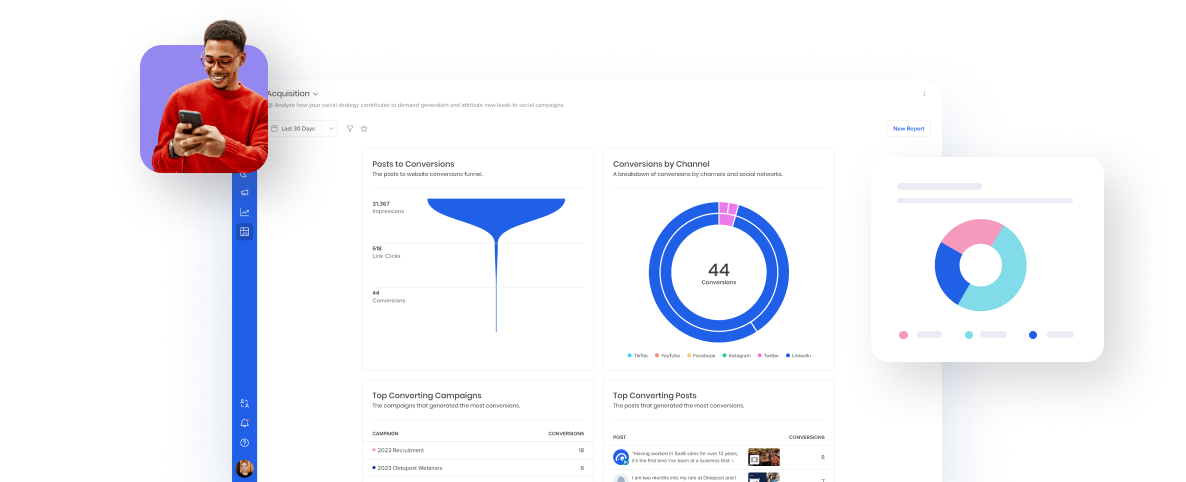
Oktopost Social BI shows which posts and campaigns drove conversions, as shown below:
Should you stop chasing reach altogether?
No, but reach should be evaluated for what it’s actually good for: brand familiarity, discoverability, community engagement, and staying visible to an audience over time. It’s not automatically wrong to chase viral moments. It’s wrong to assume a viral moment and a lead-generating moment are interchangeable measures of success.
The more useful shift is separating content goals before publishing rather than after. Some posts are built to reach broadly and build awareness. Others are built to speak precisely to a narrow, high-intent audience. Both are legitimate goals.
The mistake is reporting on both with the same metric and concluding the quiet, high-intent post underperformed because it didn’t go viral.
In summary
A post’s reach and its business impact are not the same measurement, and treating them as interchangeable leads teams to chase the wrong content.
The quiet post that never trended can still be the one doing the real work. It just shows up in branded search and delayed conversions instead of the engagement tab.
Tracking both layers, and being honest about which one a given post was built for, is what closes the gap between “great posts” and posts that actually contribute.
For more insights on how to tie social to pipeline, contact us to request a demo.
The post Viral VS quiet posts: Why your best performers might not be your best lead source appeared first on Oktopost.