If you haven’t built a “For the Press” page yet, this is your nudge to get it done. Not because it’s trendy. Because search is changing fast, this one simple page might be the cleanest, least-effort brand-protection move you can make right now.
Let me explain.
What Google’s Recent Patent Actually Means
A few weeks ago, Google filed a patent that, when you read it, kind of makes your jaw drop.
The short version: Google is giving itself the ability to rewrite your webpage using AI if it decides your page isn’t good enough for what a user is looking for. (Source: Google Patent US12536233B1)
If you’re a marketer, that probably made something in your brain short-circuit. Mine too.
As in, someone searches for information about your company, clicks through to your site, and Google may have already swapped out your page for an AI-generated version it thinks is more helpful.
And yet, it makes complete sense given everything we’ve watched Google do over the last couple of years. The direction has been clear: Google wants to own the search experience. AI Overviews, zero-click results, now this. The implications are real, and brands that haven’t thought seriously about what information exists about them online will feel it.
The Bigger Problem: AI Is Pulling from All of It
Here’s the thing most marketers haven’t fully reckoned with yet. Large language models aren’t just reading your current website. They’re reading everything.
Old reviews. Expired microsites. A LinkedIn company page someone set up in 2014 that you forgot about. A Ning profile (yes, that was briefly a thing). A social media handle that an AI keeps inventing for you because you never claimed the real one.
We’ve been dealing with this at Volume Nine firsthand. We’re almost 20 years old as an agency. Over those two decades, we’ve had different URLs, different name variations, a period where a fake agency in India was pretending to be us to scam job seekers, old Glassdoor reviews tied to that mess, microsites we spun up and abandoned, the works.
All of that is out there. And unlike older versions of Google, which would deprioritize the stale stuff, AI search is pulling it all in as data points to answer the question: “Is this brand legit? Who are they?”
When someone asks ChatGPT, “Is Volume Nine a good company?” we want the answer to come from reliable sources. Not from a scammy Glassdoor review tied to a company in India that used our name a decade ago.
That’s the problem. The “For the Press” page is one piece of the solution.
What Is a “For the Press” Page?
Think of it as an official fact sheet about your brand, living on your own website.
It’s not your About Us page. Your About Us page is (and should be) a sales page, focused on your customer, your value proposition, and your story. It’s doing critical work. You don’t want to mess with that.
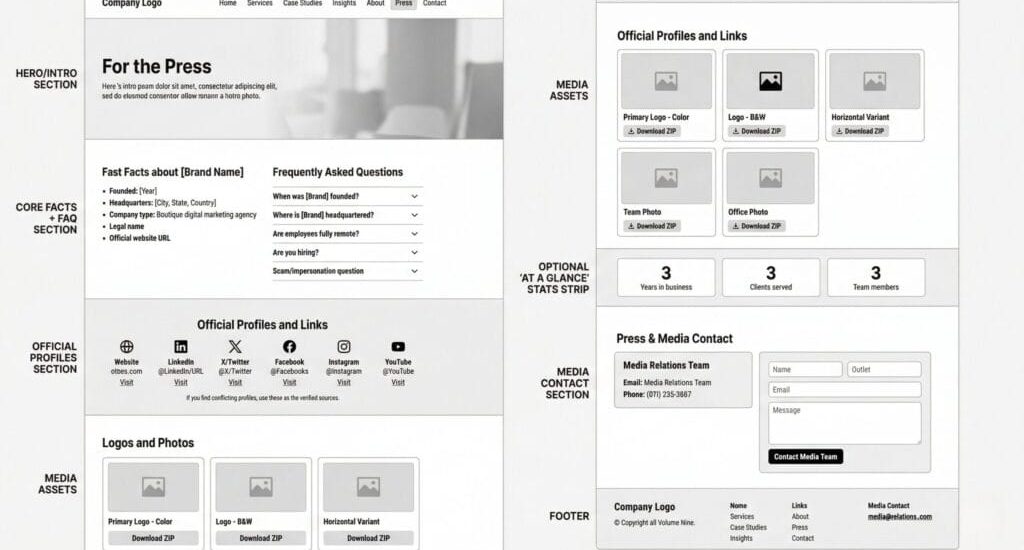
A press page is different. It’s the page where you put the official version of your company’s data. Things like:
Your official company name (and any variations)
The year you were founded
Your official website URL
Your official social media profiles, spelled out clearly
Your official bios (short and long versions)
Your logo files
Key facts about the company
It’s boring on purpose. That’s the point. You’re not trying to convert anyone with this page. You’re giving AI systems, journalists, partners, and search engines a single clean source of truth.
We set one up for Volume Nine, and it was genuinely not time-intensive. That matters because most of the AI SEO work we recommend to clients is not a small lift. A press page is.
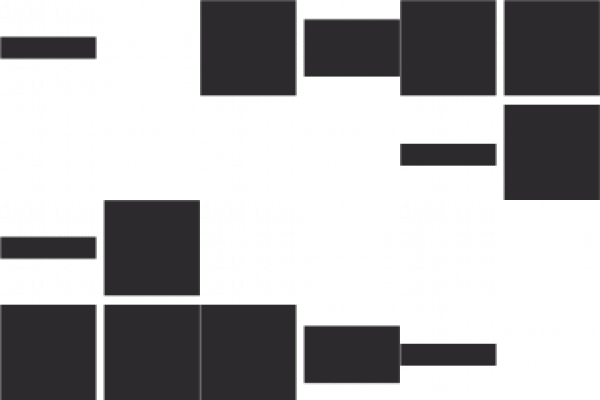
Here is a good, solid Wireframe for a PR press page:
Why It’s Not the Same as Your About Us Page
Worth saying twice because this trips people up.
Your About Us page should focus on your customers and the problems you solve. It’s often one of the most visited pages on a B2B site. It’s a conversion asset.
Your press page is a data asset. It’s not meant to persuade anyone. It’s meant to be accurate, consistent, and easy for both humans and AI to parse. (Here’s a good overview of what press pages are built to do, if you want a neutral reference point.)
If you merge them, you risk muddying the purpose of both.
What Else Should You Do?
The press page is a great starting point, but there are a few other moves worth making at the same time.
Do a brand search in ChatGPT
See what it’s saying about you. You don’t need to audit every LLM out there. They’re largely pulling from similar sources. ChatGPT is one of the biggest traffic drivers in AI search right now, so start there. Look at what information is surfacing. You might find old profiles that need updating, outdated location info, or just a thin presence that needs more authoritative sources to back it up.
Check your NAP consistency
Name, address, phone number. If you’ve moved offices, changed your company name, or rebranded in the last few years, the old stuff might still be floating around. Getting those citations cleaned up helps AI systems figure out who you actually are. We’ve written more about how NAP consistency affects rankings if you want the deeper dive. (CallRail also has a solid plain-language explainer on why NAP matters.)
Get a Wikidata entry submitted
There’s a process for this. Don’t just go to Wikidata and start typing. Follow the submission guidelines and be patient. A legitimate Wikidata entry becomes a strong third-party signal of your brand’s existence and legitimacy. The Wikimedia Foundation has written about how AI systems specifically draw on Wikidata as a machine-readable open-data backbone, which is exactly why it matters here. We also wrote a whole piece on why Wikidata matters for your brand if you want to go deeper.
Claim your Google Knowledge Panel
If Google has generated one for your brand, claim it through Google’s Business Profile tools. If one doesn’t exist yet, a combination of the steps above will often trigger it.
Use schema “sameAs.”
On your homepage or About Us page, you can use schema markup to connect your brand’s official social profiles back to your site. (Schema.org’s Organization type and sameAs property is the canonical reference if you want to hand this off to a developer.) You don’t need it on every page. Just the core brand pages. It’s a clear signal that says, “these are all officially us.”
Then, wherever you can, link things back to your new press page. You’re trying to create a web of consistent, authoritative signals that all point to the same accurate information.
This Is About Brand Survival in AI Search
We’re deep in the work of helping brands show up correctly in AI search right now. It’s one of the most interesting (and honestly, occasionally alarming) things we get to work on. The brands that are winning aren’t just publishing more content. They’re making sure the information that exists about them is clean, consistent, and findable.
The press page isn’t a magic bullet. But it’s one of the most elegant, low-barrier ways a brand can start sending better signals. And if Google’s new patent is any indication of where things are heading, having an authoritative source of truth on your own site is going to matter more, not less.
If you want to see where your brand stands in AI search right now, the V9 GEO Grader can give you a free snapshot. And if you want to talk through a broader AI SEO strategy, we’re happy to dig in.
FAQs About Brand Press Pages and AI Search Visibility
What should go on a “For the Press” page?
Your official company name and any known variations, founding year, official website, verified social media profiles, short and long bios, logo files, and key company facts. Keep it factual and current.
Is a press page different from an About Us page?
Yes. Your About Us page is a sales and storytelling asset oriented toward your customer. A press page is an informational fact sheet oriented toward accuracy. Both serve different purposes and shouldn’t be combined.
Do I need a press page even if my company isn’t getting press coverage?
Yes. Press pages aren’t just for PR purposes anymore. AI systems, LLMs, and search engines use them as structured brand signals. Having one helps those systems represent your brand accurately, whether or not any journalist is reading them.
How long does it take to build a press page?
Honestly, not long. A few hours if you’re organized, maybe a day if you need to gather logo files and get final approval on your bios. It’s one of the lowest-effort, highest-value things you can do for your AI search presence right now.
What is the Google patent about rewriting web pages?
Google’s patent US12536233B1 describes a system for generating AI-written page content tailored to specific users when Google determines the existing page isn’t sufficient. Worth reading if you want the technical details.
Where does the press page fit into an overall AI SEO strategy?
It’s a foundational step toward brand clarity, not a complete strategy. Pair it with NAP cleanup, a Wikidata entry, Knowledge Panel claiming, and schema sameAs markup for the strongest signal combination. Our GEO services page provides the full picture if you’re looking for a more comprehensive approach.